
CASE STUDY
Aligning Performance and Accountability Within a Complex Public Estate
Client: Highland Council – Property & Assets Service
Sector: Local Government
Engagement: High-Performance Diagnostic & Performance Pathway
Overview
When Highland Council’s Property & Assets Service began delivering a £1bn investment programme across one of Scotland’s largest local authority estates, the pressure was immediate and significant.
The service operates as the corporate landlord for all non-domestic Council properties — including schools, offices, depots, workshops and public buildings. It oversees acquisition, maintenance, disposal, rental income, capital investment and estate rationalisation across a vast geographic area.
The team was capable and experienced.
But senior leadership recognised a growing gap between activity and aligned delivery.
BlueSky was commissioned to conduct a structured High-Performance Diagnostic and support the service through its Performance Pathway.
The Challenge: Busy but Not Fully Aligned
The presenting concern was workload and resource pressure.
However, early conversations revealed deeper issues:
- Misalignment between perceived team priorities and corporate priorities
- Inconsistent clarity around team purpose
- Reactive working patterns driven by operational demand
- Limited protected time for strategic discussion
- Growing stakeholder scrutiny and community complaints
The team was working hard.
But there was a risk that effort was not consistently aligned with the most critical organisational outcomes.
Senior leadership wanted:
- Clearer alignment to corporate priorities
- Improved productivity and delivery discipline
- Stronger accountability within the leadership structure
- Greater confidence in project sequencing and communication
This was not a capability issue.
It was an alignment and effectiveness issue.
The Effectiveness Risk
Beyond immediate operational performance, there were longer-term risks:
- Erosion of stakeholder confidence
- Increased political scrutiny
- Strain in key partner relationships
- Cultural drift under sustained budget pressure
- Leadership bandwidth stretched by competing priorities
Performance in isolation is not enough.
Sustainable team effectiveness requires clarity of purpose, ownership and disciplined prioritisation.
Why BlueSky
Highland Council had previously worked with BlueSky through leadership development programmes and trusted both the facilitators and the methodology.
What resonated most was the diagnostic-led approach.
This was not a motivational intervention.
It was structured, evidence-based and performance-focused.
The team needed to:
- Understand what was happening
- Recognise their role in current outcomes
- Take ownership of improvement
- Align around shared priorities
BlueSky’s High-Performance Pathway provided that framework.
The Diagnostic Approach
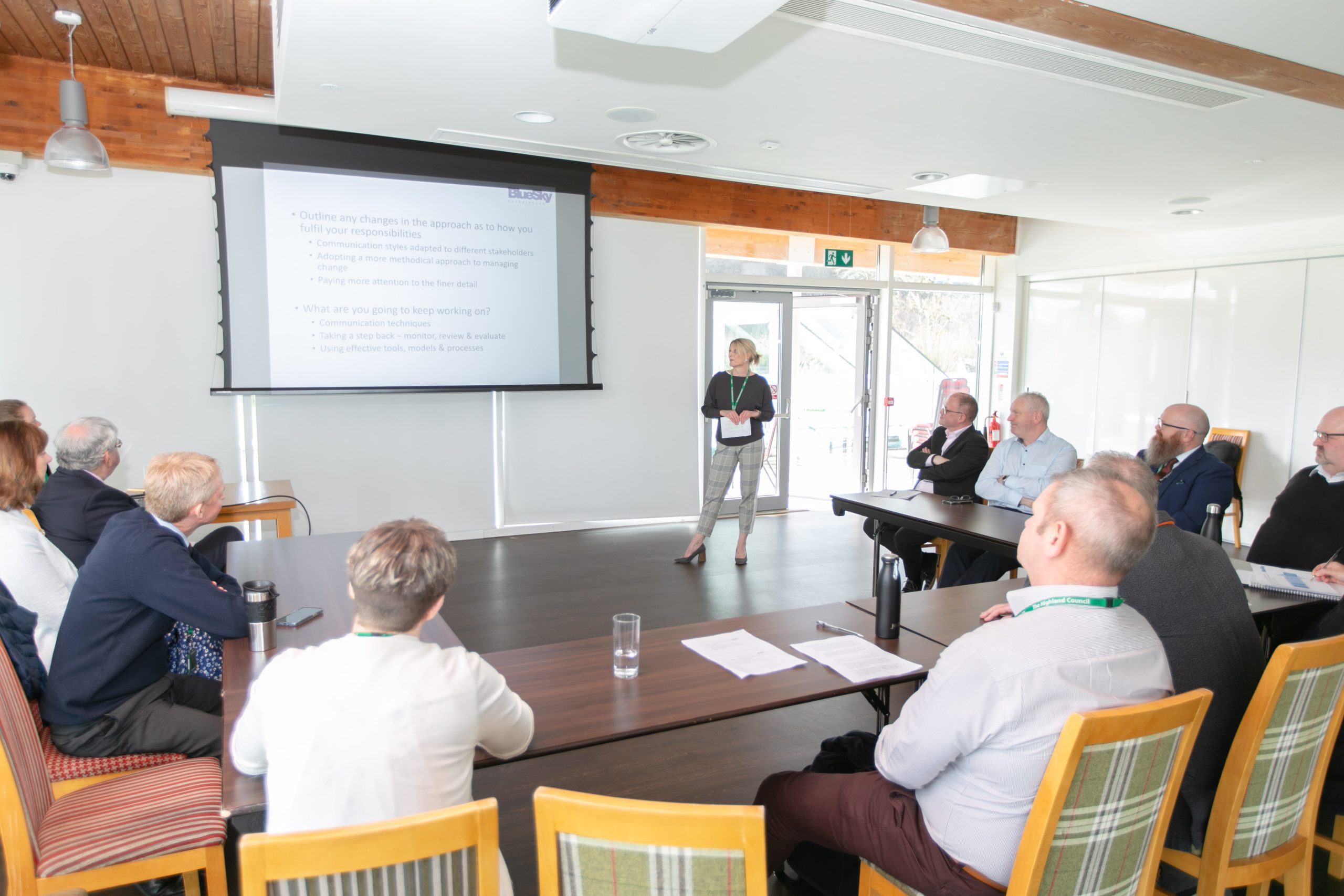
The engagement began with a structured team diagnostic process, including:
- Facilitated performance workshops
- Individual and group feedback
- Priority alignment discussions
- Clarification of team purpose
- Identification of behavioural patterns
One of the earliest insights was powerful in its simplicity:
The team rarely had protected time together to reflect on what they were doing — and why.
Creating space for structured discussion immediately surfaced:
- Differences in individual interpretations of priorities
- Assumptions around accountability
- Relationship gaps
- Over-reliance on reactive responses
The diagnostic phase created clarity.
Early Shifts in Performance
Although still early in the Performance Pathway, measurable shifts have already been observed.
Improved Executive Alignment
- Introduction of regular structured meetings with senior leadership
- More transparent communication of priorities
- Clearer reporting rhythm
Strengthened Partner Relationships
- More proactive engagement with delivery partners
- Increased face-to-face interaction
- Recognition of the importance of relationship management
Protected Team Development Time
- Dedicated time for collective reflection
- Stronger shared understanding of purpose
- Improved communication within the senior team
These are foundational performance shifts.
Leadership Ownership
One of the most important themes within the engagement has been leadership accountability.
At the outset, there was a tendency to attribute performance constraints primarily to resource limitations.
The diagnostic process challenged that narrative.
Improvement requires ownership.
BlueSky’s facilitation consistently reinforced that high performance cannot be outsourced. It must be led internally.
Encouragingly, the team has begun recognising this responsibility.
The journey now is embedding that leadership discipline consistently.
Performance vs Effectiveness
The distinction between performance and effectiveness has been central to the work.
Performance improvements observed:
- Clearer focus on the investment programme as the strategic priority
- Improved communication with senior stakeholders
- More structured engagement with delivery partners
- Better use of team development time
Effectiveness indicators emerging:
- Greater awareness of alignment gaps
- Increased openness around accountability
- Recognition of relationship-building as a strategic requirement
- Appreciation for organisational investment in team capability
Effectiveness is about sustainable capability.
That work is ongoing — but the foundations are in place.
Cultural Shift Underway
The Property & Assets Service is not struggling with interpersonal conflict.
The team is skilled and capable.
The cultural shift required is subtler:
- Moving from reactive to proactive
- From busy to prioritised
- From external attribution to internal ownership
- From fragmented activity to aligned delivery
Breaking day-to-day habits takes time.
But optimism is high.
There is recognition that this intervention represents a significant opportunity — not just for the service, but potentially as a model for other areas within the Council.
Looking Ahead
The High-Performance Pathway is ongoing, with further structured sessions planned.
The next phase will focus on:
- Embedding clarity into operational rhythm
- Strengthening leadership accountability
- Translating alignment into measurable delivery outcomes
- Sustaining behavioural discipline over time
The team is capable.
The investment is visible.
The opportunity now is execution.
Why This Matters
In complex public sector environments, high performance cannot rely on effort alone.
It requires:
- Clear alignment to corporate priorities
- Disciplined prioritisation
- Strong stakeholder relationships
- Confident leadership ownership
- Structured, diagnostic-led development
Highland Council’s Property & Assets Service demonstrates that even experienced teams benefit from stepping back, clarifying purpose and building sustainable performance capability.
This is not team building.
It is structured performance architecture.
